Cologne’s Long Game:
Updated

Share
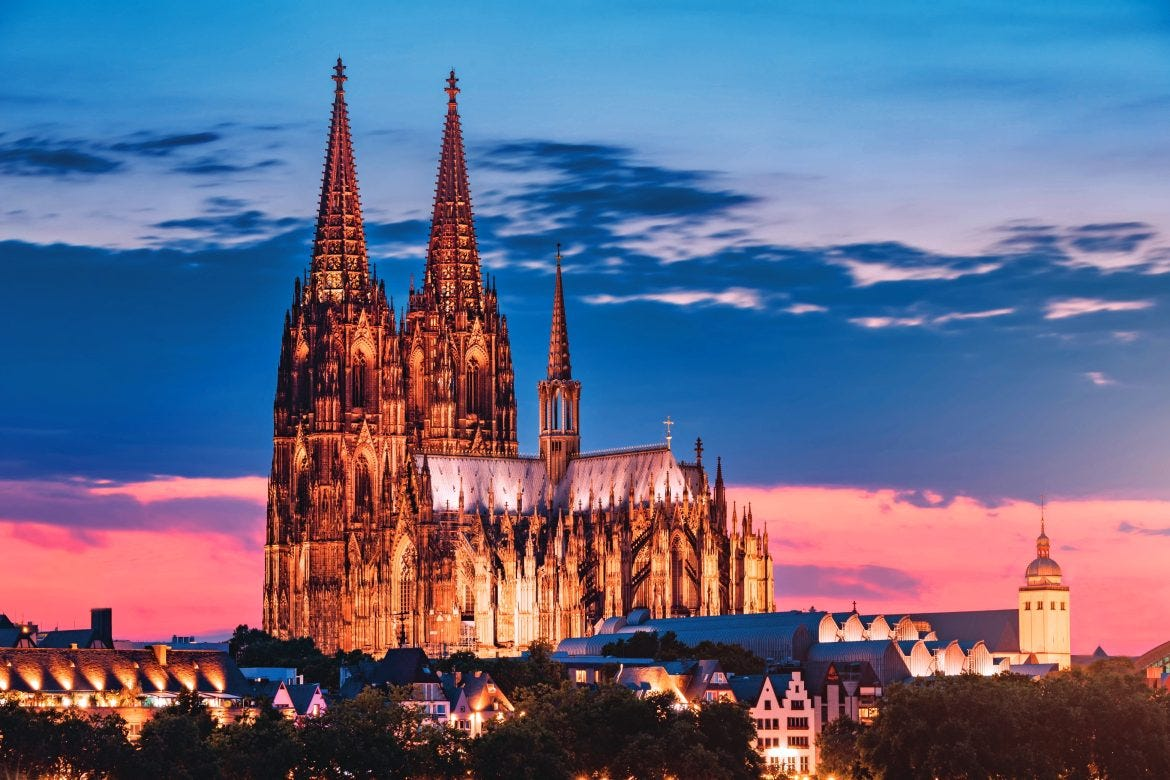
Cologne’s Long Game: Why Germany’s Most Queer-Friendly City Keeps Winning
By Jim Gladstone
Two millennia of history have conspired to make Cologne one of Europe’s most improbable success stories — a city that has been razed, rebuilt, forgotten, and rediscovered so many times that resilience has become its defining civic trait. For queer travelers, that long arc bends reassuringly in one direction: toward welcome.
A City That Refuses to Be Simple
Most Americans with a German city on their bucket list reach for Berlin, Munich, or Hamburg. Cologne — Köln in German, its name a direct descendent of the Latin Colonia — rarely makes that first cut, which is a gift to those who find it anyway. Germany’s fourth-largest city sits just east of the Belgian border on the Rhine, friendly and unhurried in ways its more famous siblings are not.
A whopping 10.6% of the population identifies as LGBTQ+. The city hosts one of Europe’s largest Pride celebrations — a two-week affair culminating in a parade that draws around 1.5 million people. It is also, by almost any measure, one of the continent’s most comfortable places to simply be — a long weekend city with a tight portfolio of essential experiences and enough breathing room left over to linger.
2,000 Years of Becoming
Understanding why Cologne feels the way it does requires a brief detour through time, because the city’s openness didn’t emerge from nowhere — it was slowly, painfully earned.
The story begins in 38 BCE, when Roman General Agrippa resettled a Germanic tribe called the Ubii on the west bank of the Rhine. The settlement grew steadily in importance, and in 50 CE, Agrippina the Younger — born there and then wife of Emperor Claudius — successfully petitioned to elevate her hometown to the rank of a colonia, a full Roman city under Roman law. It was renamed Colonia Claudia Ara Agrippinensium, a mouthful the locals eventually shortened to simply Colonia. By 90 CE, it had become the capital of the Roman province of Lower Germania, with a population of 45,000 and an aqueduct delivering 20,000 cubic meters of water daily from the Eifel hills — one of the longest in the empire. (The Römisch-Germanisches Museum sits directly atop a preserved Roman villa, its famous Dionysus mosaic still intact beneath your feet.)
Through the Middle Ages, Cologne thrived as a merchant powerhouse, controlling the flow of goods between northern Italy and England along the Rhine — the commercial internet of medieval Europe. It became one of the founding members of the Hanseatic League and, by the 15th century, was the largest city in the Holy Roman Empire. Three of the greatest Catholic philosophers of the medieval world — Albertus Magnus, Thomas Aquinas, and John Duns Scotus — all taught within its walls. The Battle of Worringen in 1288 finally broke the archbishops’ centuries-long political stranglehold, and the city became a self-governing Free Imperial City — fiercely independent, commercially savvy, and possessed of a mercantile pragmatism that would prove more durable than any single ideology.
Then came the Thirty Years’ War (1618–48), which interrupted the city’s growth and left it weakened. Then Napoleon, who ordered Eau de Cologne by the liter and restructured much of civic life under the Code Napoléon. Then industrialization under Prussian rule after 1815. Then World War II — 262 Allied air raids, 91 of 150 churches destroyed, 80% of the medieval city center reduced to rubble. Architect Rudolf Schwarz, tasked with overseeing the reconstruction, called it “the world’s greatest heap of rubble.” The city rebuilt anyway, mostly in a modest mid-century style that makes its surviving historic architecture — and its striking 21st-century additions — stand out all the more sharply. More than 75% of what you see today was built after 1945.
What survived this history was not naivety, but a particular kind of tested open-mindedness. Cologne had been Roman, Frankish, episcopal, Free Imperial, French, Prussian, and bombed into near-nonexistence. It emerged from all of it with a distinct civic character: unhurried, irreverent, and quietly proud.
The Queer Capital No One Warned You About
Cologne’s LGBTQ+ identity runs deep and long. The city’s queer community has roots in the 19th century, and by the 20th century, Cologne was a recognized hub of activism — including a critical role in Germany’s fight against HIV/AIDS through the 1980s and 90s. On June 30, 1979, the city hosted one of Germany’s first Christopher Street Day events, marking the tenth anniversary of the Stonewall riots — a small evening of films, information stands, and a dance party that has grown, improbably, into one of the largest Pride celebrations in the world. Cologne hosted EuroPride in 2002, drawing 1.2 million participants, and the event has continued to expand; 2024’s parade drew an estimated 1.4 million attendees.
Queer life here isn’t cordoned off into a single rainbow-flagged district. The nightlife concentrates around Schaafenstrasse, with over a dozen bars and clubs, but the Belgian Quarter’s cafes and vintage shops skew young and fluid; the Ehrenfeld neighborhood’s murals and repurposed spaces feel at home to anyone who doesn’t fit a tidy category. In June 1995, the city unveiled a formal memorial to gay and lesbian victims of the Nazi regime — one of only three such monuments in Germany, alongside Berlin and Frankfurt — a somber piece of gray and pink granite, the latter evoking the identifying patches forced on gay men in concentration camps. It sits in the Rheinpark, near what was for decades a well-known cruising area along the Hohenzollern Bridge, the placement a gesture of civic candor that feels distinctly Cologne.
The cathedral gets into it too. In September 2023, several priests held a blessing ceremony for 30 same-sex couples on its steps in open defiance of the diocese’s conservative archbishop — an act that drew international attention and, three months later, received indirect validation when Pope Francis authorized such blessings worldwide.
What to Actually Do
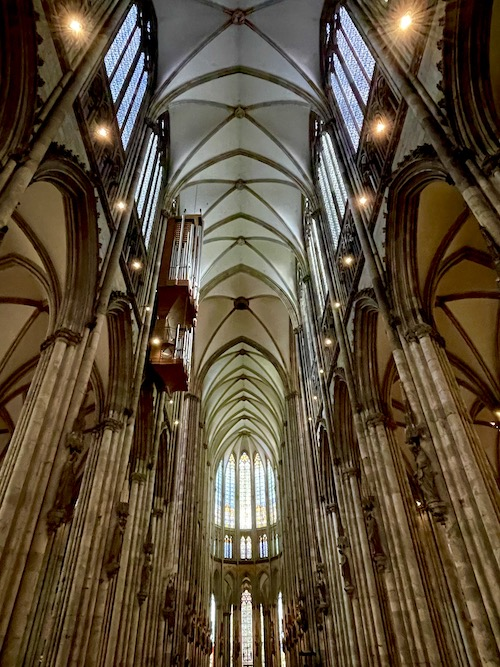
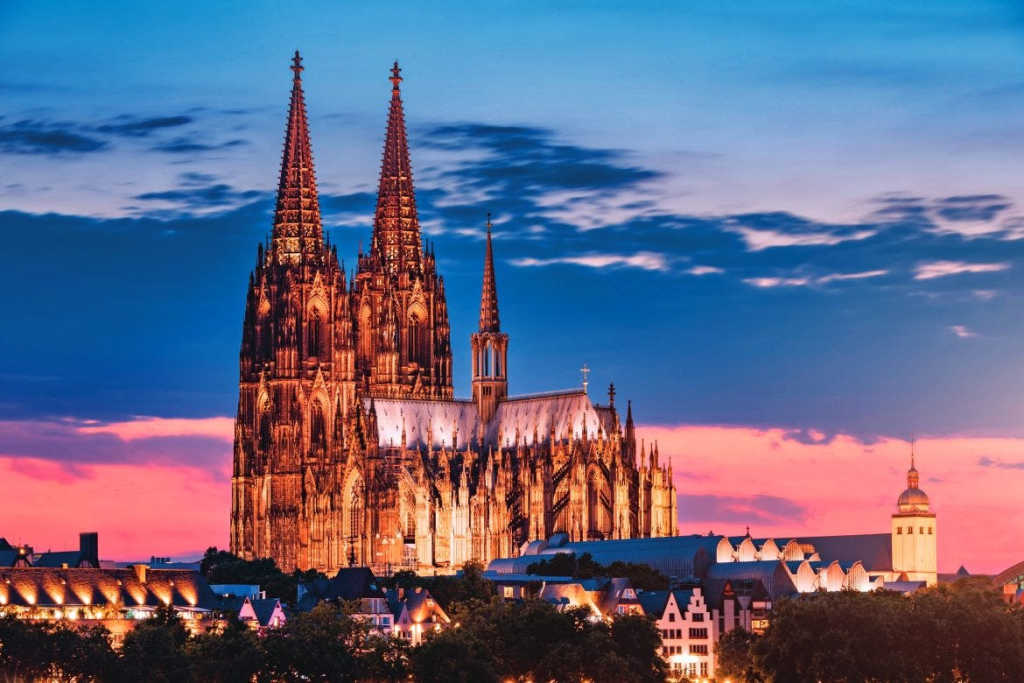
The Cologne Cathedral — the Dom — is inescapable in the best possible sense. The world’s third-tallest church, a UNESCO World Heritage Site, and Germany’s most visited landmark, it began construction in 1248, paused for 300 years during the Reformation, and finally finished in 1880. It survived WWII’s bombing partly out of reverence, partly because its twin spires made it an invaluable navigation point for Allied pilots. Inside, a 1,200-square-foot stained glass window by Gerhard Richter — 11,000 colored glass squares in 72 colors, a shimmering pixelated grid — sits in startling, gorgeous contrast to the Gothic grandeur around it.
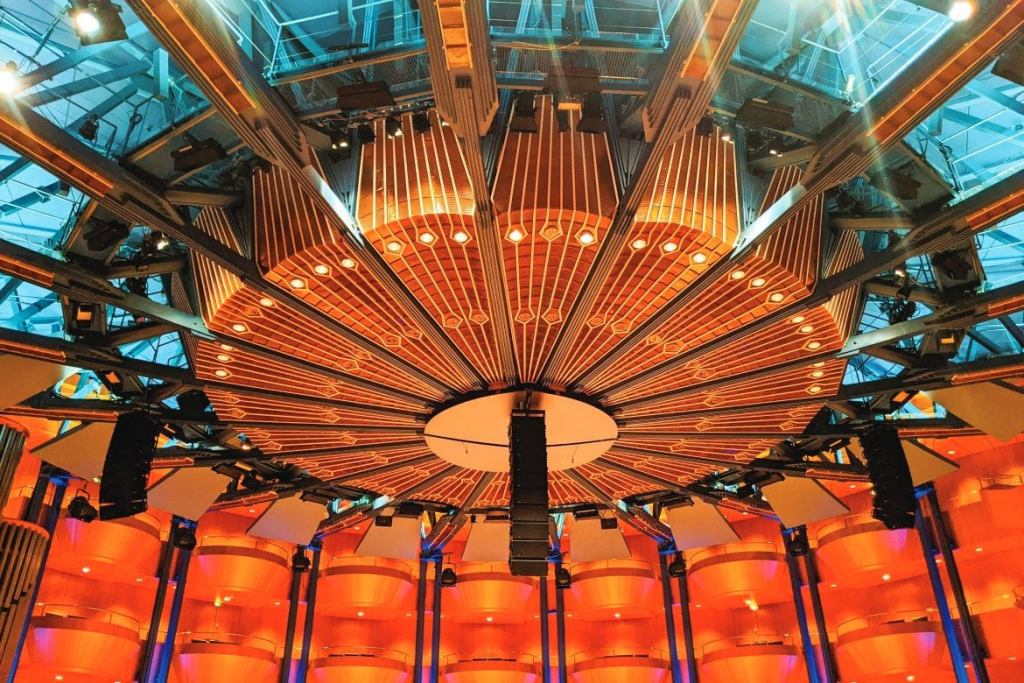
One minute’s walk brings you to Museum Ludwig, home to the world’s third-largest Picasso collection and Europe’s most extensive Pop Art holdings. Adjacent to it, the subterranean Cologne Philharmonic Hall was built without parallel walls — specifically to eliminate echo — and hosts over 400 performances a year. The Wallraf-Richartz Museum rounds out the trifecta, with works spanning medieval to early 20th century and, notably, LGBTQ+-themed private tours of the collection available with two weeks’ advance notice.
For something more sensory: the original Farina Fragrance Museum traces the 1709 invention of Eau de Cologne by Italian-born perfumer Johann Maria Farina, whose family has operated from the same building since 1723. Nearby, the Chocolate Museum follows cocoa from plantation to candy bar with an honesty about sustainability that elevates it above typical tourist fare.
Eat Reibekuchen — fried potato pancakes, crisp outside and almost creamy within, served from street carts in the old town. Drink Kölsch, the city’s pale, light, distinctly local beer served in small cylindrical glasses at brewery restaurants across town. Consider the Halver Hahn, a defiantly named open-faced cheese sandwich that appears on both street carts and Michelin-starred tasting menus. The Belgian Quarter rewards aimless wandering. Ehrenfeld, the more counterculture of the two, offers mural-splashed alleys and Club Bahnhof, a genre-fluid music venue tucked under a railroad arch.
The Long Weekend That Changes Your Map
Cologne is not a city that demands to be conquered. It rewards the traveler who slows down, follows a Romanesque church down an unplanned alley, lingers over a second Kölsch, and discovers that the most consistently welcoming city in Germany has been hiding, quite contentedly, in plain sight.
Accessible by train from much of France, Belgium, and the Netherlands, and served by budget carriers including Ryanair and Eurowings, it is the European queer long weekend that more Americans should be taking.
Further reading: History of Cologne · Cologne Tourism LGBTQ+ Guide · Römisch-Germanisches Museum · ColognePride Official · The History of Cologne Podcast
Share
Published by TalkTravel — a community of travel enthusiasts sharing real advice.
Have feedback? Contact our team.
More in Travel Destination

Travel Destination

Travel Destination
5 Days Best Itinerary Tanzania Safari: Complete Guide 2026

Travel Destination
Luxury Travels All Around the World: Elite Agencies & Prices 2026

Travel Destination
How Much is a Trip to Paris for 2: Complete Budget Guide 2026

Travel Destination
Hot Air Balloon Festival Melbourne 2026 Complete Guide

Travel Destination
7-10 Day Andalusia Journey: Complete Travel Guide 2026

Travel Destination
African Tours and Safaris Wildlife Guide 2026: Complete Planning

Travel Destination
Travel to Japan 2026: Complete Guide with Costs, Visa Tips & Itineraries