
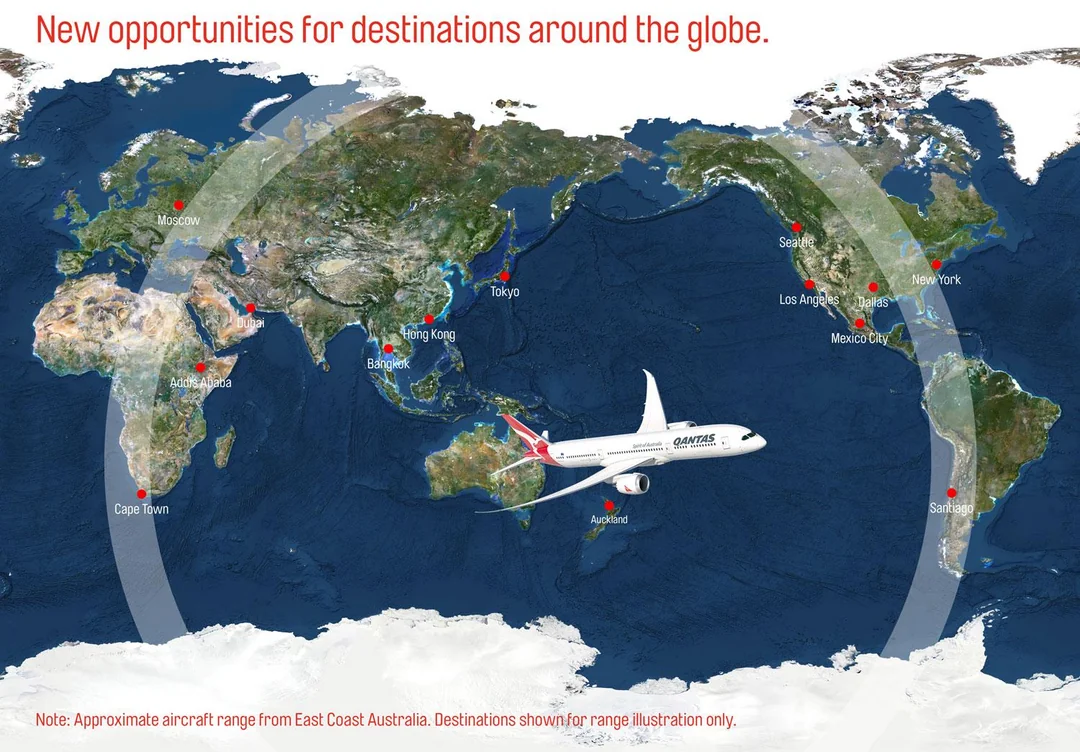
Came across an old 2015 concept image from Qantas showing potential long-haul routes for the Boeing 787 Dreamliner, including places like Mexico, Seattle, Tokyo, Hong Kong, Bangkok, Dubai, Cape Town, and even Addis Ababa.
Looking back, a large number of those “direct range” routes never materialized.
What changed?
1. Fleet reality vs. initial plans
Early messaging suggested up to ~50 Dreamliners
Reality: Qantas ended up with ~14, and Jetstar Airways with ~11
That dramatically limited network expansion capability
2. Strategy shift
Qantas prioritized high-yield, proven routes (e.g., Australia–US, flagship long-haul)
Ultra-long-haul focus shifted toward Project Sunrise instead of broad 787 network expansion
3. Hub economics still matter
Even with 787 range, many routes (e.g., Africa, secondary Europe) aren’t profitable without strong demand
One-stop routes via hubs often outperform risky nonstop launches
4. External factors
COVID disrupted long-haul growth plans
Aircraft delivery timelines and capital constraints slowed expansion
Bilateral agreements and airport constraints also play a role
The “what if” scenario
If Qantas had taken the full 50 aircraft:
More direct long-haul routes likely (especially Asia + secondary US cities)
Potential retirement or redeployment of older Airbus A330 fleet
Stronger global network independence instead of reliance on partners
Bottom line
The 2015 map was more aspirational marketing than a firm route plan. The Dreamliner enabled those routes but economics, fleet size, and strategy ultimately determined what actually launched.
 6
6