
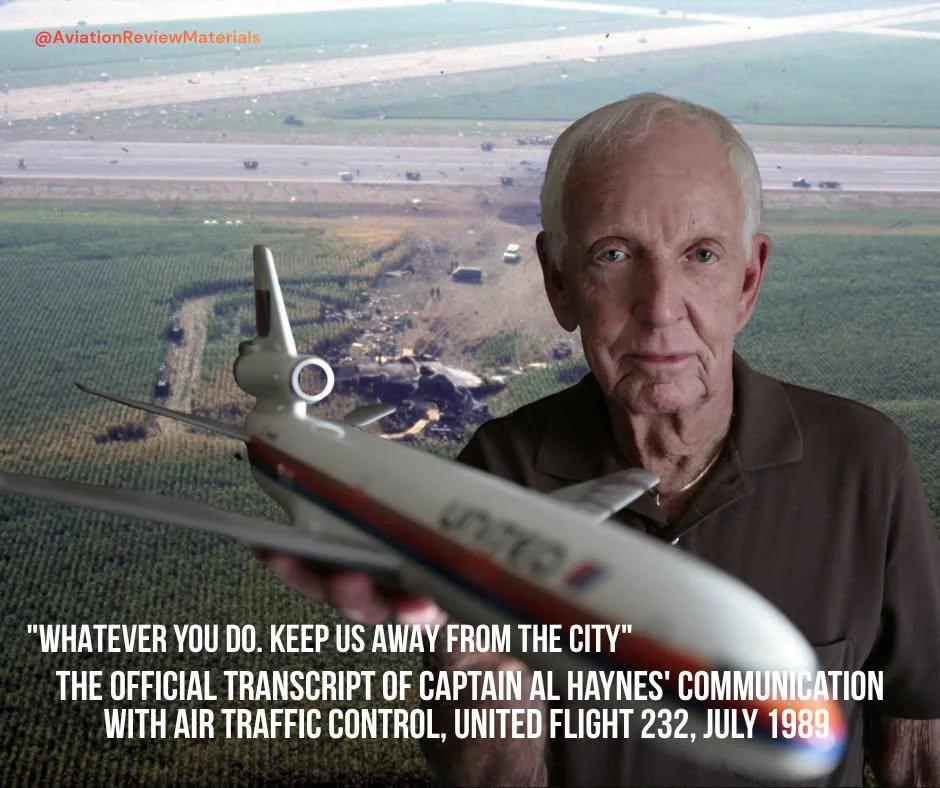
On July 19, 1989, United Airlines Flight 232 departed Denver for Chicago with 296 people onboard. About an hour into the flight, the tail-mounted General Electric CF6 engine suffered an uncontained failure. While an engine failure alone is normally manageable, debris from the explosion severed all three independent hydraulic systems, leaving the aircraft without conventional flight controls. The crew instantly lost the use of the ailerons, elevators, rudder, spoilers, flaps, and slats. Since engineers believed this type of failure was nearly impossible, there was no emergency checklist for the situation.
Captain Al Haynes, First Officer William Records, Flight Engineer Dudley Dvorak, and off-duty DC-10 training captain Dennis Fitch worked together to find a solution. Through experimentation, they discovered they could partially control the aircraft by adjusting thrust on the two remaining wing-mounted engines. Differential engine power allowed them to make slow turns and control the aircraft's descent well enough to attempt an emergency landing.
As the aircraft approached Sioux Gateway Airport, air traffic controllers cleared the airspace while emergency responders prepared for impact. Despite having almost no control authority, the crew guided the aircraft toward the runway. It touched down at roughly 215 knots, far faster than a normal landing. The right wing struck the runway first, causing the aircraft to roll, break apart, and catch fire. Even so, 184 of the 296 people onboard survived, making it one of the most remarkable survival stories in aviation history.
The investigation traced the accident to a microscopic manufacturing defect in a titanium fan disk inside the tail engine. Over time, the flaw expanded until the disk failed catastrophically. The accident led to major improvements in engine inspection techniques, hydraulic system safety analysis, and aircraft flight control design.
Flight 232 is also remembered as one of the greatest examples of Crew Resource Management. Captain Haynes consistently credited the outcome to the teamwork between the cockpit crew, cabin crew, air traffic controllers, and emergency responders rather than individual heroics. Later simulator testing demonstrated just how difficult the situation was, with many experienced pilots unable to replicate the crew's achievement. Haynes famously reflected on the experience by saying they were too busy solving the problem to be afraid, emphasizing that maintaining composure was essential to survival.
 0
0