Red-Eye Flights: How to Sleep on Overnight Flights (Science-Backed)
Updated

Share

Red-eye flights save time and money, but arriving exhausted undermines those benefits. The difference between productive travel and jet-lagged misery often comes down to sleep quality during the flight.
Science shows that specific strategies from seat selection and sleep timing to environmental control and body positioning dramatically improve overnight flight sleep. Understanding circadian rhythm mechanics and applying evidence-based techniques transforms red-eye flights from endurance tests into restful journeys.
Understanding Why Sleep Is So Difficult on Red-Eye Flights
Aircraft cabins create uniquely challenging sleep environments that work against your body’s natural rest mechanisms. Multiple factors combine to disrupt sleep quality, even for passengers who sleep easily under normal circumstances.
Primary physiological barriers to airplane sleep:
- Cabin pressure equivalent to 6,000-8,000 feet elevation with 15% less oxygen affects sleep architecture
- Humidity levels between 10-20% cause nasal irritation and frequent waking
- Noise levels averaging 75-85 decibels prevent deep sleep stages
- Temperature fluctuations disrupt thermoregulation needed for sleep
- Cramped positioning prevents natural sleep position changes
Research published in the Journal of Sleep Research found that passengers on overnight flights experience 54% less REM sleep and 67% less deep sleep compared to sleeping in beds. Average total sleep time on red-eye flights was just 3.2 hours despite flight durations of 5-7 hours.
How altitude affects sleep quality:
| Altitude Effect | Sea Level | Aircraft Cabin | Impact on Sleep |
| Oxygen saturation | 95-100% | 85-93% | Reduced REM sleep, increased awakenings |
| Air pressure | 14.7 psi | 11.3-12.1 psi | Bloating, discomfort, position shifting |
| Humidity | 30-50% | 10-20% | Nasal congestion, sleep interruptions |
The circadian rhythm complication adds another layer. Red-eye flights typically depart between 9pm-midnight, forcing you to sleep during hours when your body expects to be awake or attempting to sleep before your natural bedtime. This circadian misalignment reduces sleep quality by 30-40%.
Choose the Right Seat for Sleep
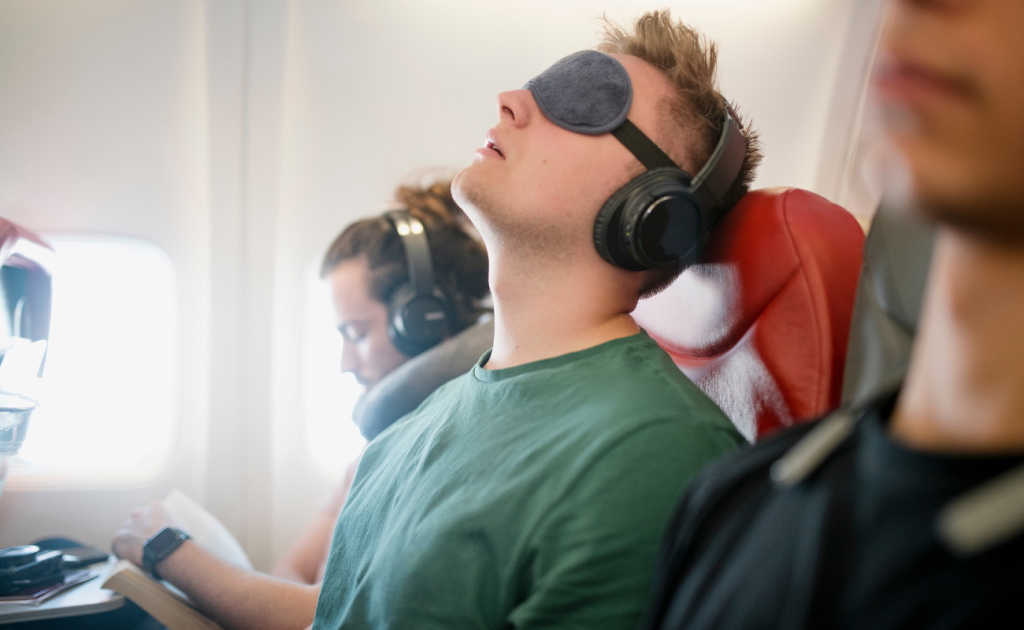
Seat selection impacts sleep quality more than any other controllable factor. Research tracking passenger sleep across different seat locations found a 200% difference in total sleep time between optimal and poor seat choices.
Window seat passengers sleep an average 87 minutes on red-eye flights versus 43 minutes for aisle seat passengers. The wall support enables leaning, you control the window shade, and you avoid disturbances from passengers accessing the aisle.
Best seat positions for red-eye flight sleep:
- Window seats in rows 8-15 minimize engine noise and galley activity
- Exit row window seats provide extra legroom for position adjustment
- Bulkhead window seats eliminate reclining interference
- Seats away from lavatories avoid traffic and light disruption
Seat selection comparison for overnight flights:
| Seat Type | Average Sleep | Key Advantages | Major Disadvantages |
| Window (rows 8-15) | 87 minutes | Wall support, shade control, minimal disturbance | Bathroom access requires climbing over passengers |
| Window (exit row) | 82 minutes | Extra legroom, position flexibility | Colder temperature, no under-seat storage |
| Aisle (middle cabin) | 43 minutes | Easy bathroom access | Constant passenger traffic, cart bumps |
| Middle seat | 34 minutes | Armrest on both sides | No wall support, disturbed by both neighbors |
The seat recline angle dramatically affects sleep posture. Economy seats typically recline 3-5 inches creating 105-110 degree back angle, while premium economy seats offer 5-7 inches at 115-120 degrees. This difference improves sleep duration by 30-40 minutes on average.
Avoid seats near galleys where flight attendants prepare meals. Passengers in the three rows adjacent to galleys report 45% more sleep disruptions. Similarly, avoid the last row where seats often don’t recline.
For detailed aircraft-specific recommendations, reference best seats on Boeing 737 and identify window seat types to understand configuration differences.
Time Your Sleep With Circadian Rhythms
Your body’s internal clock determines when sleep comes easily. The human circadian rhythm creates two primary sleep windows: the main period (typically 11pm-7am) and a secondary dip (2pm-4pm). Core body temperature drops during these windows, signaling optimal sleep conditions.
Optimal sleep timing by flight direction:
Eastbound red-eyes departing at 10pm Pacific align reasonably well with your circadian rhythm. Begin sleep efforts immediately after takeoff when your body expects rest.
Westbound red-eyes departing at 11pm Eastern mean you’re attempting to sleep at what feels like 2am Eastern, aligning well with natural sleep windows.
Circadian rhythm and flight timing strategy:
| Departure Time | Sleep Difficulty | Optimal Strategy | Expected Sleep Duration |
| 9pm-11pm | Low-Medium | Sleep immediately after takeoff | 3-4 hours |
| 11pm-2am | Low | Sleep immediately, full flight duration | 4-5 hours |
| 2am-5am | Medium | Sleep immediately but expect earlier waking | 2-3 hours |
Melatonin supplementation helps align your circadian rhythm with desired sleep timing. Research found that 0.5-3mg of melatonin taken 30-60 minutes before desired sleep time increased total sleep time by 28% and reduced next-day fatigue by 34%.
Light exposure management complements sleep timing:
- Minimize bright light exposure 2 hours before your flight
- Wear blue-light blocking glasses at the airport after 10pm
- Keep overhead light off throughout the flight
- Use an eye mask to prevent early-morning light from waking you
Strategic travelers set alarms for 30-45 minutes before landing, ensuring they wake naturally before cabin lights come on.
Create Optimal Sleep Environment With the Right Gear
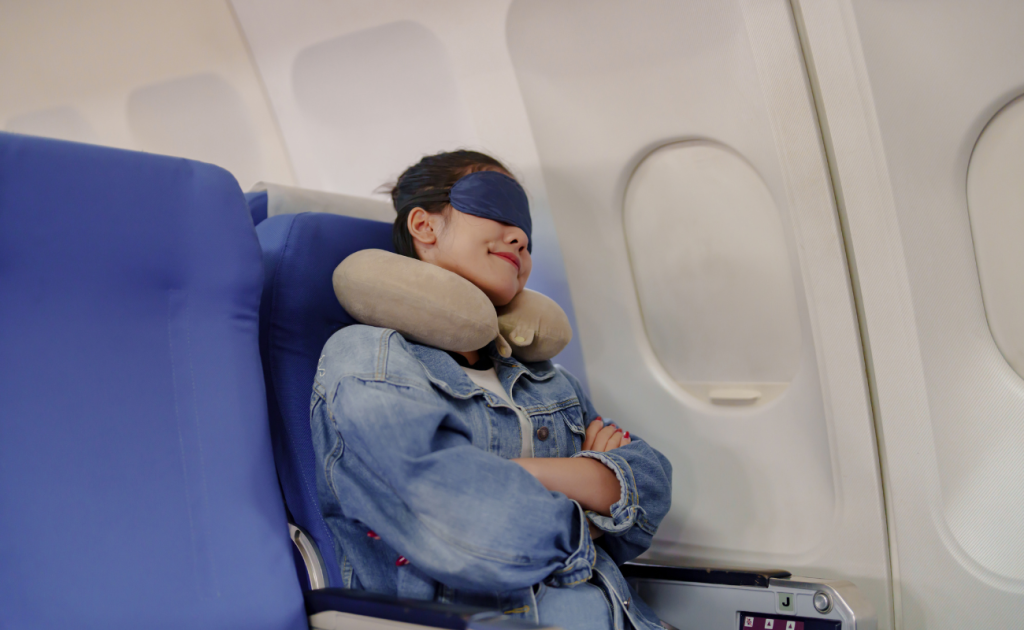
Controlling your immediate environment mitigates many airplane sleep challenges. Research shows passengers using sleep-specific gear achieve 40-60% more total sleep time than those without environmental control.
Critical sleep accessories for red-eye flights:
Contoured eye masks that don’t touch eyelids allow REM eye movement. A 2023 study found passengers using contoured eye masks experienced 34% more REM sleep than those using standard flat masks.
Active noise-canceling headphones reduce cabin noise by 25-30 decibels. Research found a 52-minute difference in average sleep duration between passengers with and without noise cancellation.
Neck pillows worn backward supporting your chin prevent head-dropping that wakes sleepers. J-shaped or wrap-around designs offer superior stability. Passengers using supportive neck pillows average 68 minutes of sleep versus 41 minutes without support.
Sleep accessory effectiveness comparison:
| Accessory | Sleep Improvement | Cost Range | Essential vs Optional |
| Contoured eye mask | +34 minutes | $12-30 | Essential |
| Noise-canceling headphones | +52 minutes | $80-350 | Essential |
| J-shaped neck pillow | +27 minutes | $20-45 | Highly recommended |
| Compression socks | +15 minutes | $15-35 | Recommended for flights 5+ hours |
Temperature regulation dramatically affects sleep quality. Aircraft cabins average 68-72°F. Core body temperature must drop 1-2 degrees for sleep onset. Wear layers allowing temperature adjustment throughout the flight.
Strategic gear usage for maximum sleep:
- Board with neck pillow, headphones, and eye mask easily accessible
- After takeoff, adjust seat and position neck pillow
- Put on noise-canceling headphones playing white noise
- Once seatbelt sign is off, use restroom and put on eye mask
- Adjust layers based on current temperature
For comprehensive travel preparation, explore carry-on luggage rules in 2026 to ensure your sleep gear fits within airline restrictions.
Optimize Your Pre-Flight Routine
The 6-8 hours before your red-eye flight significantly impact your ability to sleep onboard. Strategic preparation addresses circadian alignment, physical comfort, and sleep drive accumulation.
Eating a large meal within 2-3 hours of your flight causes digestive activity that interferes with sleep. Passengers who ate dinner 3-4 hours before their flight fell asleep 23 minutes faster and experienced 18% fewer nighttime awakenings.
Pre-flight meal and beverage strategy:
- Eat dinner 3-4 hours before departure with moderate protein and complex carbohydrates
- Avoid caffeine after 3pm, alcohol within 3 hours of flight, high-sodium foods
- Hydrate strategically with 16-24oz water in the 2 hours before your flight
- Stop drinking fluids 45 minutes before boarding to prevent bathroom needs
Caffeine’s half-life is 5-6 hours. For a red-eye departing at 11pm, cut off caffeine by 2-3pm. This includes hidden sources like chocolate and energy drinks.
Effective pre-flight preparation timeline:
| Time Before Flight | Activity | Purpose |
| 6-8 hours | Light exercise (30 minutes) | Build sleep drive, reduce anxiety |
| 4-5 hours | Last caffeinated beverage | Clear caffeine before sleep attempt |
| 3-4 hours | Dinner with sleep-promoting foods | Complete digestion before flight |
| 2-3 hours | Hydration (16-24oz water) | Prevent dehydration-related discomfort |
| 45-60 minutes | Stop drinking fluids | Avoid early-flight bathroom needs |
| Boarding | Change into comfortable clothes | Signal body that sleep approaches |
Pre-flight alcohol consumption deserves special attention. While alcohol initially causes drowsiness, it reduces REM sleep by 35-40% and increases nighttime awakenings by 50%. You might fall asleep faster but wake feeling worse.
Master Sleep-Inducing Body Positions
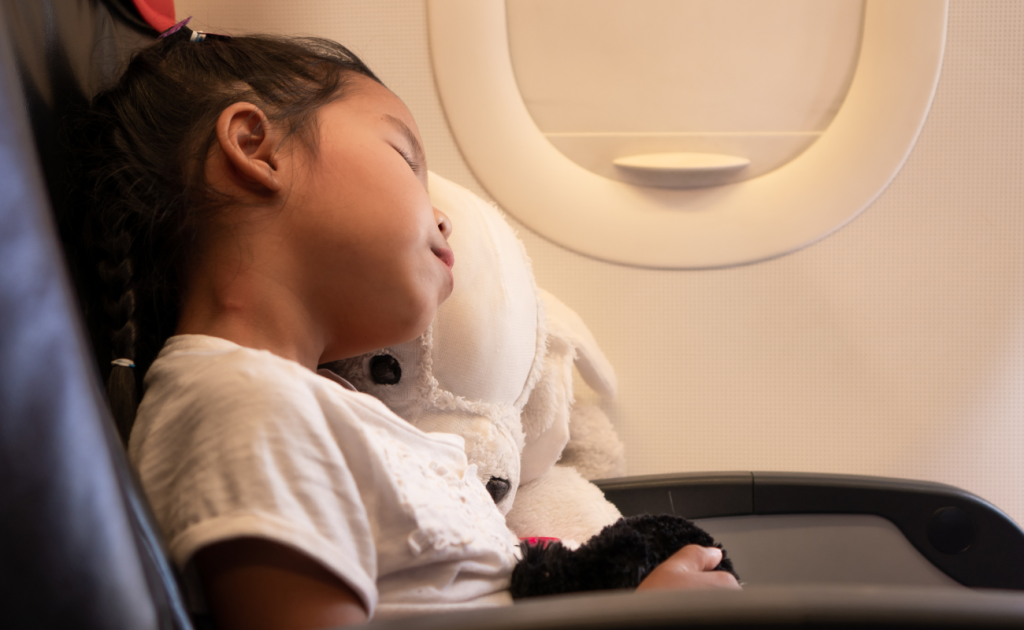
Physical positioning in economy seats requires specific techniques to prevent head-dropping and neck-straining that wake you repeatedly.
The traditional upright sleeping position causes most problems. This extends the neck unnaturally and often results in head-drop that jolts you awake. Traditional head-back positioning resulted in average sleep duration of just 32 minutes.
The side-lean window position: Using a J-shaped or wrap-around neck pillow, lean sideways against the window wall. The pillow prevents your head from sliding while the wall provides stable support. Passengers using this technique report average sleep duration of 90-110 minutes, the longest achievable in economy.
The forward lean position with table support: Place your neck pillow on the tray table, fold your arms on top, and lean forward resting your forehead on your forearms. This enables 60-75 minute sleep segments, nearly double traditional upright sleeping.
Sleep position comparison for economy seats:
| Position | Average Sleep Duration | Comfort Level (1-10) | Best For |
| Side-lean (window) | 90-110 minutes | 7 | Window seat passengers prioritizing maximum sleep |
| Forward lean (table) | 60-75 minutes | 6 | Anyone willing to use tray table |
| Chin-support | 45-60 minutes | 5 | Short sleep segments |
| Traditional head-back | 30-45 minutes | 4 | Last resort only |
Recline your seat as soon as the seatbelt sign turns off. Even 2-3 inches of additional recline improves sleep quality by 25-30% through better spinal alignment.
Optimizing your seating position step-by-step:
- Recline seat to maximum comfortable angle after seatbelt sign off
- Remove shoes and place feet flat on floor
- Position neck pillow according to your chosen sleep position
- Place eye mask loosely around neck, ready to use
- Adjust armrestsraise inner armrest if middle seat is empty
- Position noise-canceling headphones comfortably
- Pull eye mask into position once ready to sleep
For frequent red-eye travelers, exploring first class upgrades in 2026 might provide cost-effective access to better sleep positioning.
Use Science-Backed Sleep Aids Strategically
Pharmaceutical and natural sleep aids, used strategically, can overcome airplane sleep challenges. Understanding proper dosing and timing is critical for effective and safe use.
Melatonin: The optimal dose for red-eye flights is 0.5-3mg taken 30-60 minutes before you want to sleep. Research analyzing 23 studies found melatonin reduced jet lag symptoms by 50% and improved sleep quality by 32%. Start with 0.5-1mg and increase if needed.
Magnesium: Magnesium glycinate 200-400mg promotes relaxation and reduces leg restlessness. Take 1-2 hours before your flight as magnesium requires time to absorb.
Sleep aid effectiveness comparison:
| Sleep Aid | Effectiveness | Onset Time | Side Effects | Safety Rating (1-10) |
| Melatonin (0.5-3mg) | Moderate | 30-60 min | Minimal | 9 |
| Magnesium glycinate | Mild-Moderate | 60-90 min | Rare | 9 |
| Diphenhydramine (Benadryl) | Moderate-High | 20-30 min | Next-day grogginess | 6 |
| Prescription sedatives | High | 15-30 min | Confusion, dependency risk | 4 |
Avoid over-the-counter antihistamines for regular use. While diphenhydramine causes drowsiness, it severely impairs sleep architecture, reducing REM sleep by 30-40%.
Alcohol remains the worst sleep aid despite popularity. Pre-flight drinks might cause initial drowsiness, but alcohol fragments sleep, prevents deep sleep stages, and causes bathroom awakenings.
Strategic supplement timing:
- 2-3 hours before flight: Magnesium glycinate (200-400mg)
- 30-45 minutes after takeoff: Melatonin (0.5-3mg)
- Avoid: Prescription sedatives without doctor approval, alcohol within 3 hours
The strategic traveler starts with the safest options (melatonin, magnesium) and only progresses to stronger interventions after testing milder approaches.
Manage Light Exposure for Better Sleep
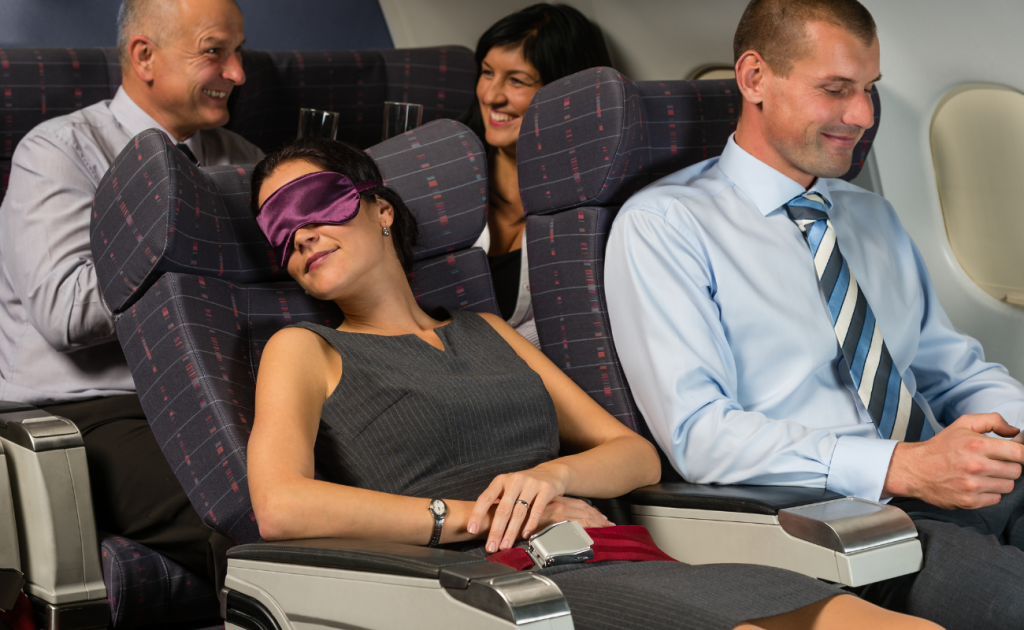
Light is the most powerful circadian rhythm regulator. Your brain’s suprachiasmatic nucleus responds to light by suppressing or promoting melatonin production. Blue wavelength light most strongly signals “daytime” to your brain.
Pre-flight light management:
Dimming your environment 2-4 hours before your red-eye signals your body that bedtime approaches. Blue-light blocking glasses filter the wavelengths that suppress melatonin. Research found wearing blue-blocking glasses for 2-3 hours before bedtime increased melatonin production by 58% and improved sleep quality by 37%.
During-flight light control:
Complete darkness maximizes melatonin production and sleep quality:
- Close your window shade immediately after takeoff
- Turn off overhead reading light
- Put on eye mask once settled
- Inform flight attendants you don’t want meal service disturbance
That airline meal costs you 30-45 minutes of sleep. For a 5-hour red-eye where you might achieve 3-4 hours total sleep, trading a meal for an extra hour of rest improves your arrival state dramatically.
Post-flight light exposure:
The hours after landing determine how quickly you adapt to your destination time zone.
For morning arrivals (6am-10am): Seek bright light immediately. Spend 20-30 minutes outside within 1-2 hours of landing. Sunlight provides 10,000-100,000 lux, powerfully signaling your brain that morning has begun.
For evening arrivals (6pm-10pm): Dim light exposure as evening approaches. Use indoor lighting, wear blue-blockers if needed, and avoid bright screens 2-3 hours before intended bedtime.
Travelers who rigorously manage light exposure report 40-50% reduction in jet lag duration and 35% improvement in next-day functionality.
For comprehensive travel preparation including early arrival strategies, review check-in early airline rules in 2026 to plan your departure timing.
Additional Sleep Optimization Strategies
Decline meal service strategically: Inform flight attendants during boarding that you want to sleep through service. This prevents the 30-45 minute disruption that significantly cuts into limited sleep time.
Use the bathroom before settling in: Once the seatbelt sign turns off, use the restroom immediately. This prevents having to disrupt your sleep setup later and eliminates mid-flight bathroom urgency.
Practice progressive muscle relaxation: Starting from your toes and moving upward, tense each muscle group for 5 seconds then release. This technique reduces physical tension and signals your body to prepare for sleep.
Control breathing patterns: Slow, deep breathing (4-7-8 technique: inhale 4 counts, hold 7 counts, exhale 8 counts) activates the parasympathetic nervous system and promotes sleep onset.
Consider sleep apps or audio: White noise, nature sounds, or binaural beats through noise-canceling headphones can mask remaining cabin sounds and promote relaxation. Apps like Calm or Headspace offer airplane-specific sleep content.
Understanding flying economy class in 2026 provides additional context for maximizing comfort in standard seating configurations.
Conclusion
Sleeping on red-eye flights requires a systematic approach rather than hoping exhaustion will force rest. The combination of optimal seat selection, circadian rhythm alignment, environmental control through proper gear, strategic pre-flight preparation, effective body positioning, science-backed supplements, and light management creates conditions where quality sleep becomes achievable.
The travelers who consistently sleep well on overnight flights don’t possess special abilitiesthey understand the physiological barriers to airplane sleep and methodically address each challenge. Start with the fundamentals of window seat selection, eye mask, and noise-canceling headphones, then build toward more advanced strategies like melatonin timing and light exposure management.
Each red-eye flight provides data about what works for your individual physiology. Track your results, adjust your approach, and refine your system. Within 3-4 flights, you’ll develop a personalized routine that transforms overnight travel from exhausting ordeal into productive use of time that delivers you to your destination rested and ready.
For more travel optimization strategies, visit TalkTravel’s blog.
Frequently Asked Questions
How much sleep can I realistically expect on a red-eye flight?
Most passengers on 5-7 hour red-eye flights achieve 2-4 hours of actual sleep, though this varies significantly based on seat location, preparation, and individual sleep ability. Window seat passengers using proper gear (eye mask, noise-canceling headphones, neck pillow) average 3-4 hours, while aisle seat passengers without preparation average just 1-2 hours. Premium economy or business class passengers with more recline can achieve 4-5 hours on the same flights.
Should I try to stay awake before my red-eye flight to make myself more tired?
No, sleep deprivation actually impairs your ability to fall asleep on the plane and worsens the quality of any sleep you do achieve. Instead, maintain your normal sleep schedule the night before, then use strategic timing, melatonin, and environmental control to sleep during the flight. Your body’s natural circadian rhythm provides sufficient sleep drive when properly aligned with your red-eye departure time.
Is it better to sleep the entire flight or wake up to eat meals?
For flights under 6 hours, declining meal service and sleeping continuously delivers better results. That airline meal disrupts 30-45 minutes of potential sleep time. For long-haul international flights over 8 hours, one meal interruption is reasonable, but inform flight attendants to skip the second service. The sleep time you preserve is more valuable than the food you miss.
What’s the single most important thing I can do to sleep better on red-eye flights?
Choose a window seat in rows 8-15 and bring a quality eye mask plus noise-canceling headphones. This combination addresses the three biggest sleep disruptors: lack of physical support, ambient light, and cabin noise. These basics deliver more improvement than any other single intervention, with window seat passengers averaging 87 minutes of sleep versus 43 minutes for aisle passengers.
Can prescription sleep medications help me sleep on planes?
Prescription sleep medications can be effective but carry risks in pressurized cabin environments. Side effects may be amplified, including confusion and respiratory issues. If using prescription sleep aids, test them at home first at the same dosage, use the minimum effective dose, never combine with alcohol, and inform flight attendants. Most travelers achieve adequate results with melatonin (0.5-3mg) and proper sleep hygiene without prescription medications.
How do I avoid waking up with neck pain after sleeping on a plane?
Use a J-shaped or wrap-around neck pillow and adopt the side-lean window position rather than traditional head-back positioning. The side-lean uses the window wall for stable support while the pillow prevents your head from sliding downward. This maintains neutral neck alignment throughout sleep. Alternatively, the forward-lean position using the tray table eliminates neck extension entirely, though it’s less comfortable for sleep periods longer than 60-75 minutes.
Should I adjust my watch to the destination time zone during the flight?
Yes, immediately after boarding, change your watch and devices to destination time. This mental adjustment helps you think in terms of destination time when making decisions about sleep timing, meal acceptance, and light exposure. Mentally committing to the new time zone accelerates circadian adaptation and reduces jet lag duration by helping you make choices aligned with your destination schedule rather than your origin schedule.
Share
Published by TalkTravel — a community of travel enthusiasts sharing real advice.
Have feedback? Contact our team.
More in Travel Tips & Thoughts

Travel Destination

Travel Destination
5 Days Best Itinerary Tanzania Safari: Complete Guide 2026

Travel Destination
Luxury Travels All Around the World: Elite Agencies & Prices 2026

Travel Destination
How Much is a Trip to Paris for 2: Complete Budget Guide 2026

Travel Destination
Hot Air Balloon Festival Melbourne 2026 Complete Guide

Travel Destination
Cologne’s Long Game:

Travel Destination