Introduction
The economy cabin in 2026 sits at a crossroads. Airlines are simultaneously investing billions in premium upgrades while tightening restrictions on their cheapest seats. With seat pitch shrinking to as low as 28 inches on budget carriers and basic economy fares stripping away loyalty benefits, the picture looks grim for budget travelers.
Yet free WiFi rollouts, improved inflight entertainment, and better connectivity suggest some genuine improvements are happening. So what’s the real story? The data reveals a divided reality that depends entirely on which ticket you buy.
The Premium Push: Airlines Are Betting Big on First Class, Not Economy
The numbers tell a clear story. Airlines expect record profits of $41 billion in 2026, yet they’re earning just $7.90 per passenger according to the International Air Transport Association. Where’s the money coming from? Premium seats.
Delta and United captured nearly all U.S. airline profits through the first nine months of 2025. Their strategy involves adding lounges, first-class cabins, and premium amenities for travelers willing to pay more. Meanwhile, airfare is expected to remain flat in 2026 compared to 2025, according to American Express Global Business Travel forecasts.
The class divide is widening fast. Premium seats account for only 6% of total global seat capacity but generate disproportionate revenue. Forward bookings for premium economy jumped 48% for the first half of 2026 at carriers like Emirates and Delta.
What This Means for Economy Passengers
The airline industry focus has shifted dramatically toward high-paying customers. American Airlines calls 2026 the year of implementation for premium improvements planned years ago. JetBlue is introducing domestic first class in mid-2026. Even Southwest, traditionally focused on affordable fares, is adding premium seats with extra legroom.
For economy passengers, this premium obsession comes with a cost. Resources once spread across all cabin classes now flow disproportionately to the front of the plane. The mesh curtain separating classes has become a wall.
Seat Pitch Reality: How Much Legroom Are You Actually Getting?
Legroom measurements reveal the uncomfortable truth about modern economy flying. Average seat pitch in economy ranges from 30 to 32 inches across major carriers. But these averages hide dramatic variations.
Current Seat Pitch Breakdown by Carrier
| Airline | Average Seat Pitch | Status |
| JetBlue Airways | 32.7 inches | Best in class but reducing to 30 inches on some A320s by 2026 |
| Southwest Airlines | 31.8 inches | Maintaining current standards |
| Alaska Airlines | 31 inches | Stable offering |
| Delta AirLines | 31 inches | Standard economy; 34-35 inches in Comfort+ |
| American Airlines | 30.2 inches | Standard across fleet |
| United Airlines | 30.1 inches | 34-38 inches in Economy Plus |
| Hawaiian Airlines | 29 inches | Approaching uncomfortable territory |
| Frontier Airlines | 28 inches | Ultra-low-cost carrier |
| Spirit Airlines | 28 inches | Ultra-low-cost carrier |
The concerning trend involves seat pitch reductions to maximize capacity. JetBlue, historically the most generous U.S. carrier, is reconfiguring its A320 fleet to reduce 80% of economy seats from 34 inches to 32 inches by 2026. This change accommodates the new Mini Mint premium cabin while squeezing more passengers into existing space.
Budget carriers operate at the extreme end. At 28 inches, Frontier and Spirit offer the tightest spacing in the industry. For reference, the International Air Transport Association considers 30-32 inches the baseline for basic comfort.
Health and Comfort Implications
Limited legroom isn’t just uncomfortable. Medical experts warn that seat pitch below 30 inches increases deep vein thrombosis risk due to restricted leg movement. Taller passengers face the worst conditions, often unable to sit comfortably for hours-long flights.
The seat pitch squeeze hits hardest on longer domestic routes where passengers can’t escape cramped conditions for 5-6 hours. If you’re planning a long flight, understanding your aircraft’s seat map becomes essential. Resources like SeatGuru help identify specific seat measurements before booking.
Basic Economy Restrictions: The Real Cost of Cheap Tickets
The basic economy transformed from airline experiment to industry standard over the past few years. In 2026, these fares come with punishing restrictions that fundamentally change the flying experience.
What Basic Economy Takes Away
Airlines stripped basic economy tickets down to bare minimum offerings. Here’s what you lose when booking the cheapest fare:
American Airlines made waves in December 2025 by eliminating all mileage earnings for basic economy passengers. Previously, AAdvantage members earned 2 miles per dollar spent. Now they earn zero. The airline joins Delta in completely excluding basic economy from loyalty participation.
United blocks carry-on bags for most basic economy passengers, forcing them to check bags at added expense or squeeze everything into a personal item. The carrier also eliminates complimentary upgrades even for elite status members.
Air Canada’s 2026 basic economy rules are among the strictest. Tickets are completely locked after the 24-hour booking grace period. No same-day changes. No standby options. Miss your flight and you forfeit everything except possibly some taxes.
The Hidden Costs Add Up Fast
The savings from basic economy often disappear once you add necessary features back. Consider a typical Hawaii route example:
You save $50-75 booking basic economy versus regular economy. But then you need to pay $120-200 roundtrip to restore flexibility, seat selection, and loyalty earnings. Add checked bag fees of $30-35 each way. Suddenly you’re paying more than the regular economy would have cost initially.
For families, the math becomes worse. Multiply those upgrade costs by four passengers and basic economy stops making financial sense. You also risk being separated from traveling companions since seat assignments happen at check-in.
The upgrade to standard economy has become essential for most travelers who value any flexibility or comfort. Basic economy serves its purpose for last-minute travel with no checked bags and complete schedule certainty. For everyone else, it’s a false economy.
If you frequently fly and want to maintain your loyalty status, avoiding basic economy is crucial. Learn more about maximizing your travel benefits with programs like TSA PreCheck, Global Entry, and CLEAR.
Free WiFi Revolution: Finally, Something Actually Getting Better
Amid the doom and gloom, one genuine improvement stands out. Free inflight WiFi is finally becoming standard on U.S. carriers in 2026.
American Airlines launched free high-speed WiFi for AAdvantage members in January 2026, sponsored by AT&T. The service covers over 2 million flights annually on aircraft equipped with Viasat and Intelsat connectivity, roughly 90% of the fleet. Testing began in December 2025 on select flights from major hubs.
Delta pioneered this shift in 2023 by installing Viasat systems across its fleet and offering complimentary WiFi to all SkyMiles members. The service now extends to A220s, A330s, A350s, 737s, 717s, and 767s, plus Delta Connection regional jets.
United Airlines rolled out free WiFi for MileagePlus members in 2025, installing Starlink systems fleet-wide. Southwest followed suit with free connectivity for Rapid Rewards members. Alaska Airlines plans its free WiFi launch in 2026.
International Carriers Join the Movement
British Airways announced a major Starlink deal for free gate-to-gate WiFi across all cabins starting in 2026. Virgin Australia will complete fleet-wide Starlink installation by late 2027, with initial availability in third quarter 2026.
The technology improvements are substantial. Modern satellite systems from Viasat and Starlink offer speeds comparable to home broadband. Passengers can stream videos, take video calls, and work seamlessly at 35,000 feet.
The Catch: Not All WiFi Is Created Equal
Free WiFi comes with important caveats. American’s long-haul fleet with Panasonic connectivity remains excluded from complimentary service. These Boeing 777s and some 787s still charge for WiFi on international routes.
The free offerings also require loyalty program membership. Casual travelers who don’t belong to frequent flyer programs still pay standard rates. Given membership is free, this represents a minor hurdle for most passengers.
Speed and reliability vary significantly by aircraft and provider. Older Panasonic systems lag far behind newer Viasat and Starlink installations. Your actual experience depends entirely on which specific aircraft operates your flight.
Despite limitations, free WiFi represents genuine progress for economy passengers. Staying connected used to cost $10-20 per flight or require expensive monthly subscriptions. Now it’s included for loyalty members across most domestic routes. For business travelers and digital nomads, this single improvement might offset other economy class deterioration.
Inflight Entertainment and Amenities: The Mixed Picture
Beyond WiFi, other economy cabin improvements show mixed results. Newer aircraft feature better entertainment systems, but not all planes receive these upgrades equally.
What’s Actually Improving
Airlines are installing larger seatback screens with better resolution on new aircraft deliveries. The Boeing 787 and Airbus A350 typically feature 10-13 inch touchscreens with extensive content libraries. Some carriers offer 4K screens in newer configurations.
Streaming options expanded significantly. Many carriers now offer app-based entertainment on personal devices, eliminating reliance on seatback systems. Delta, United, and American all provide extensive streaming libraries accessible via smartphone or tablet.
USB charging ports became nearly universal across mainline aircraft. Even budget carriers now include them in most seats. Some newer planes add 110V power outlets in economy, though availability remains inconsistent.
What Hasn’t Changed or Got Worse
Food service in the domestic economy remains largely non-existent on flights under 4 hours. Passengers buy snack boxes at inflated prices or bring their own food. International routes maintain meal service, though quality varies dramatically by carrier.
Blankets and pillows disappeared from most domestic economy flights years ago. Some carriers sell comfort kits for $5-10 on longer routes. International flights still provide these basics, but quality has declined noticeably.
Seat comfort actually worsened on many aircraft. Airlines installed slimline seats with less padding to reduce weight and create more rows. While technically offering similar seat pitch, these thinner seats feel less comfortable on longer flights according to passenger feedback.
Remember to check current carry-on luggage rules for 2026 before packing for your flight, as regulations continue evolving.
Regional and International Variations: Not All Economy is Equal

The economy experience varies dramatically by region and carrier. What U.S. passengers endure differs substantially from European or Asian standards.
European Carriers: Short-Haul Reality
The European short-haul economy offers minimal frills. Ryanair and EasyJet lead the race to the bottom with seats as tight as 30 inches and aggressive ancillary fees. Even legacy carriers like British Airways offer limited service on intra-European routes.
The European model treats short-haul routes like bus service in the sky. You get from point A to B efficiently but with minimal comfort. Given most European flights last under 3 hours, passengers tolerate conditions they’d reject on longer routes.
Asian Carriers: Raising the Bar
Singapore Airlines, All Nippon Airways, and Japan Airlines consistently receive top ratings for economy service. Average seat pitch runs 32-34 inches. Meals remain standard even on shorter regional flights. Service levels exceed U.S. carriers across all metrics.
The difference stems partly from cultural factors and partly from competitive dynamics. Asian carriers compete heavily on service quality, making economy passengers a priority rather than an afterthought.
Middle Eastern Excellence
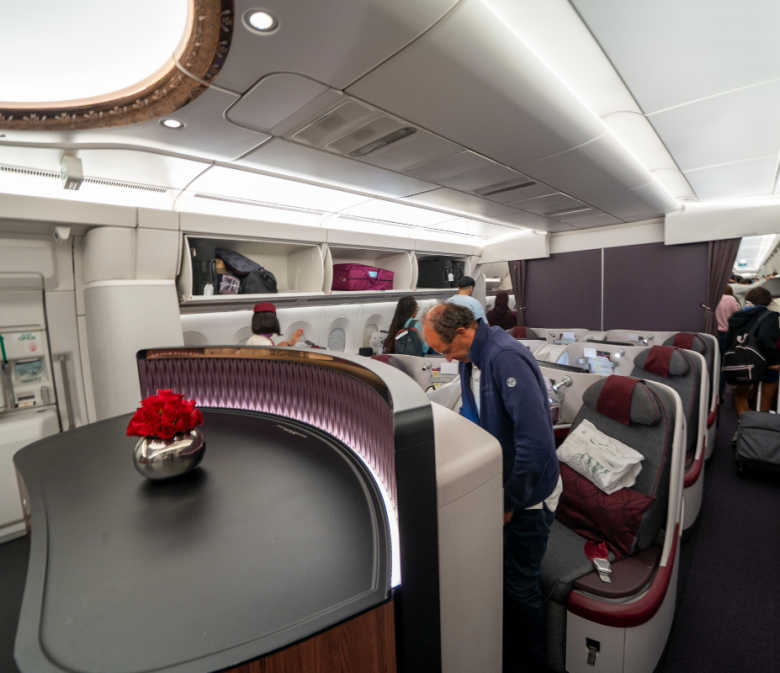
Emirates, Qatar Airways, and Etihad transformed long-haul economy expectations. These carriers offer 32-34 inch pitch as standard, comprehensive entertainment systems, quality meal service, and attentive cabin crew. The onboard experience rivals what U.S. carriers offer in premium economy.
These airlines subsidized by oil-wealthy governments can afford to compete on service rather than price alone. The result gives passengers glimpses of what economy could be if profitability weren’t the sole driver.
What Passengers Can Do: Strategies for Better Economy Flying
Smart passengers can improve their economy experience through strategic planning and program participation. Here are proven tactics that work in 2026:
Loyalty Programs Matter More Than Ever
Join every relevant frequent flyer program even if you rarely fly. Free WiFi, better boarding groups, and potential upgrades all require membership. Most programs cost nothing to join and maintain.
Elite status unlocks significant benefits even in basic economy. Complimentary upgrades, free checked bags, priority boarding, and seat selection privileges transform the experience. If you fly 25-50 times annually on one carrier, pursuing status makes sense.
Credit Cards Provide Surprising Value
Airline co-branded credit cards bypass many basic economy restrictions. Cards like the Citi AAdvantage and United Explorer provide free checked bags, priority boarding, and other perks that offset annual fees after just a few flights.
The best cards also offer statement credits for WiFi purchases and other inflight spending. Do the math on your annual flying patterns. A $95 annual fee pays for itself quickly if you fly four or more times per year.
Seat Selection Tools Are Essential
Never book blindly. Use SeatGuru, ExpertFlyer, or airline seat maps to identify the best available seats before committing. Exit rows, bulkhead seats, and specific aircraft types make enormous differences in comfort.
Check aircraft changes before flying. Airlines swap planes regularly and your carefully selected seat on a 737-900 might disappear if they substitute a different aircraft. Monitoring seat assignments up until departure prevents unpleasant surprises.
When packing electronics, review guidelines on flying with lithium batteries to avoid security delays.
Timing and Route Selection
Consider routing through less congested airports when possible. Smaller hubs often feature newer aircraft with better configurations. A connection through Austin or Nashville might offer better planes than a direct flight from Newark.
Book early for seat selection but wait for fare drops if possible. Airlines release their best economy seats 11 months out but often drop prices closer to departure. The tradeoff between seat selection and price requires careful calculation.
Red-eye flights and off-peak travel times frequently feature emptier planes where you might score extra space. Tuesday and Wednesday flights generally have lower load factors than weekends.
Pack Strategically
Master the personal item and carry-on size restrictions to avoid checking bags on basic economy fares. A properly sized backpack holds surprisingly more than you’d expect when packed efficiently.
Bring your own entertainment on older aircraft without good streaming options. Download Netflix content, load e-books, or carry a tablet with stored media. Don’t rely on airline-provided entertainment on older domestic planes.
Noise-canceling headphones transform the economy experience more than any single purchase. Quality models from Bose or Sony block engine noise and crying babies, making even long flights tolerable.
For more strategies, explore these airport hacks that make traveling easier.
The Verdict: Better and Worse Simultaneously
So is economy class getting better or worse in 2026? The honest answer is both, depending entirely on your ticket type and expectations.
The Improvements Are Real
Free WiFi across major U.S. carriers represents genuine progress. Being connected at 35,000 feet for free eliminates a significant pain point and expense. This single improvement adds substantial value to the economy experience.
Newer aircraft with better entertainment, USB ports, and more reliable amenities gradually replace aging planes. When you luck into a brand-new 737 MAX or A321neo, the experience exceeds flights from even five years ago.
Some carriers maintain decent economy standards. JetBlue, despite recent changes, still offers more legroom than competitors. International carriers like Singapore and Emirates prove the economy doesn’t have to mean misery.
The Deterioration Accelerates
Seat pitch continues shrinking across the industry. What averaged 32 inches a decade ago now sits at 30 inches or less on many carriers. The physical space passengers occupy decreased measurably and will keep decreasing.
Basic economy restrictions reached punishing levels. Losing all loyalty earnings, upgrade eligibility, and flexibility transforms these tickets into bare-minimum transportation. The savings rarely justify the sacrifices unless you have absolutely zero needs beyond reaching your destination.
The premium focus means economy improvements happen as afterthoughts if at all. Airlines direct investment and attention toward high-paying passengers. Economy gets the minimum required to fill seats at the lowest possible cost.
Conclusion
Economy class fractured into distinct tiers. Regular economy with some flexibility and benefits exists at one level. Premium economy offers real improvements at significant upcharge. Basic economy strips everything away for minimal savings. The question isn’t whether the economy got better or worse in 2026. It’s which version of the economy you’re experiencing. The cheapest tickets deliver declining value and increasing restrictions. Pay slightly more for the regular economy and some improvements become visible.
For most passengers, the sweet spot sits in regular economy on carriers offering decent amenities. Avoid ultra-low-cost carriers unless price is your only consideration. Join loyalty programs even if you fly rarely. Check seat maps obsessively. These simple steps separate tolerable economy flying from genuinely miserable experiences. The divide between premium and basic passengers will keep widening. Airlines discovered they can squeeze more revenue from fewer premium passengers than masses of budget travelers. That calculation drives every decision affecting economy class in 2026 and beyond.
The flying economy isn’t dead. But it requires more research, planning, and strategic thinking than ever before to avoid the worst aspects while capturing whatever improvements exist. Your experience depends entirely on the choices you make before ever stepping on the plane.
For the latest updates on air travel developments and more helpful guides, visit Talk Travel regularly.
Frequently Asked Questions
Is economy class getting smaller in 2026?
Yes, seat pitch in economy continues decreasing at many carriers. JetBlue is reducing legroom from 34 inches to 32 inches on most seats during its A320 reconfiguration. Budget carriers operate at 28 inches, which is below the 30-32 inch industry average. Physical space allocated to economy passengers is shrinking as airlines add more rows to increase capacity.
What are basic economy restrictions in 2026?
Basic economy tickets in 2026 carry severe restrictions across major carriers. American Airlines eliminated all mileage earnings for basic economy passengers. United blocks carry-on bags except for elite members. Air Canada allows no changes after the 24-hour booking window. Most carriers assign seats at check-in, block upgrades, and board basic economy passengers last. These tickets function as minimal transportation with almost no flexibility.
Which airlines offer free WiFi in economy class?
American Airlines, Delta, United, Southwest, and Alaska Airlines all offer free WiFi to economy passengers who are loyalty program members as of 2026. International carriers including British Airways and Virgin Australia are rolling out free WiFi fleet-wide. Membership in frequent flyer programs is required but costs nothing to join. Some long-haul aircraft with older Panasonic systems remain excluded from complimentary service.
How can I get more legroom in economy without paying for premium seats?
Exit row seats and bulkhead rows offer additional legroom in economy at no extra cost when available at check-in. Join airline loyalty programs for better seat selection access. Use co-branded airline credit cards that provide free seat upgrades or early selection privileges. Elite status holders receive complimentary access to extra-legroom seats on their primary carrier. Booking early increases chances of securing better economy seats before they’re taken.
Are international economy flights better than domestic flights?
Generally yes. International carriers, particularly those from Asia and the Middle East, maintain higher economy standards than U.S. domestic flights. Airlines like Singapore, Emirates, and ANA offer 32-34 inch seat pitch as standard, provide meals on all flights, and deliver better service levels. The European short-haul economy resembles U.S. domestic service with minimal amenities. Long-haul international routes from any carrier typically exceed domestic economy quality.
Should I avoid basic economy tickets completely?
Not necessarily, but basic economy works only for specific situations. If you travel with only a personal item, have completely fixed plans with zero chance of changes, and don’t care about loyalty earnings or seat selection, basic economy saves money. For everyone else, the restrictions create more problems than the savings justify. Business travelers, families, and anyone valuing flexibility should pay extra for regular economy.
What’s the best airline for economy class legroom in 2026?
JetBlue offers the most generous average economy legroom at 32.7 inches, though this is decreasing on some aircraft. Southwest provides 31.8 inches consistently across its fleet. Among legacy carriers, Alaska and Delta tie at 31 inches. International carriers like Singapore Airlines and Japan Airlines typically offer 32-34 inches on long-haul routes, exceeding U.S. domestic standards.
Do airlines still provide free snacks in economy?
Domestic U.S. flights under 4 hours typically offer only free non-alcoholic beverages and limited snacks like pretzels or cookies. Longer domestic flights and most international routes include meal service in economy. Quality and quantity vary significantly by carrier. Budget carriers charge for all food and drinks. Premium international carriers provide substantial meals even in economy on flights over 2-3 hours.
How do I find out my plane’s seat configuration before booking?
Use SeatGuru or the airline’s own website to view detailed seat maps before booking. Enter your flight number and date to see the specific aircraft type and configuration. These tools show seat pitch, width, and amenities for each aircraft. Airlines sometimes substitute different planes, so check again closer to departure. Most airline booking engines now display seat maps during the purchase process.